Pickling Brine pH Calculator: Estimate Your Brine pH Before Canning
Free, no-signup tool that estimates the pH of your pickling brine. Your actual recipe, with your own choice of vinegars, water, salt, sweeteners, and the ground spices and dried herbs you simmer into the liquid. Built for home canners working with their own brine concoctions and tested recipes alike.
Why brine pH matters in water bath canning
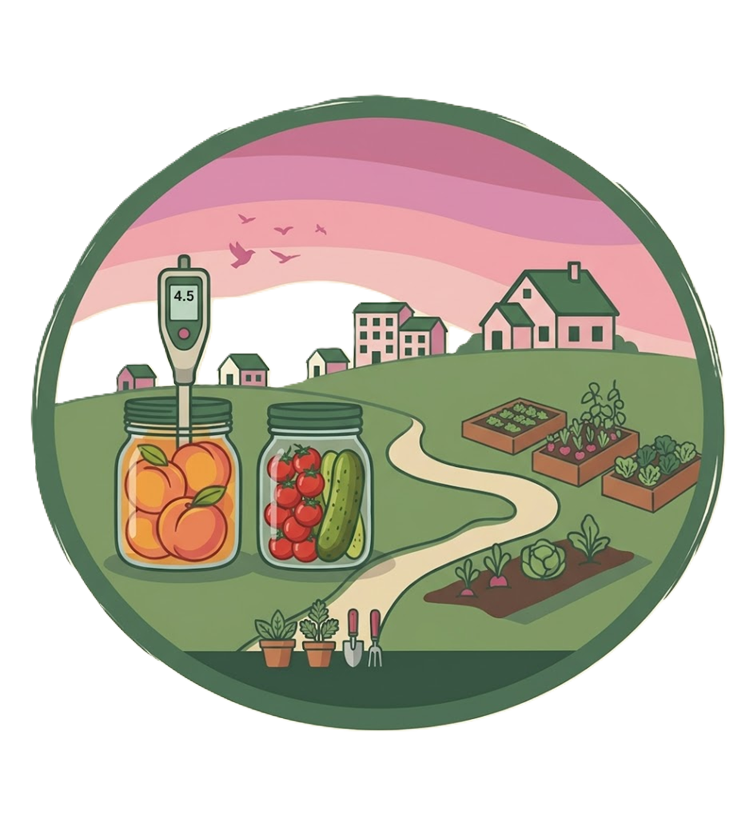
When you pickle vegetables and process them in a boiling water bath canner, the acid in your brine is what keeps the jar safe on the shelf. Heat alone is not enough. A boiling water bath kills active spoilage organisms, such as molds, yeasts, and common vegetative bacteria. However, it doesn’t get hot enough to destroy Clostridium botulinum spores. What stops those spores from germinating is a low pH environment. The acidity has to be high enough (pH 4.6 or below) to prevent the spores from waking up and producing the deadly botulism toxin, keeping the sealed jar completely safe on your shelf.
That’s why every tested water bath canning recipe for pickles specifies a ratio of vinegar to water, a specific acidity level of that vinegar, and a specific amount of acid relative to the vegetables.
The brine pH calculator on this page estimates the pH of your full brine. Not just the vinegar and water, but the lemon juice, citric acid, dissolved sugar and salt, soy sauce or mirin, and the ground spices and dried herbs that get cooked into the liquid. It tells you whether your brine is starting from a sensible place, before you’ve added the vegetables, before you’ve processed, before you’ve measured with a meter.
Think of it as a sanity check on the brine portion of any recipe: yours, your grandmother’s, or one you’re adapting from a tested source.
Brine pH calculator
Estimates the pH of your pickling liquid before it goes into the jar.
This tool estimates brine pH. Always pair it with a tested recipe and a pH meter before canning. Why this matters
This tool does
- Estimate the pH of your brine. The liquid you make on the stove.
- Give you a number to plan with before you measure.
- Flag brines that fall above the 4.6 safety threshold for water bath canning.
This tool does not
- Tell you whether a recipe is safe to can.
- Account for what happens after the food goes in the jar. Vegetables, fruit, and garlic absorb some of the brine's acid.
- Replace a tested canning recipe.
- Work for oil-based preparations.
Add what you dissolve or simmer into the pickling liquid on the stove. That's vinegar, water, acid, salt, sweeteners, and ground spices or dried herbs. Whole spices and other jar additions stay out. They go into the jar at pack time and aren't part of the pickling liquid itself.
Base
Acids & vinegars
Liquid sweeteners
Dry ingredients
Spices in the brine ground or dried, simmered in the pot
Spices in the brine are ground or dried. Dry mustard, ground turmeric, dried oregano. You add these to the pot and simmer them in. They dissolve into the brine.
Spices in the jar are whole. Peppercorns, mustard seed, bay leaves. You drop these directly into each jar at pack time. They flavour the brine over time but don't dissolve into it.
We include spices in the brine in your formulation record so your saved recipe is complete. The tool doesn't factor them into the pH number because at typical canning quantities, their effect on pH is too small for the calculation to capture reliably.
Your brine formulation
Estimated brine pH
Equipment recommendation
Confirm your pH before you can
A pH meter or test strips give you a direct reading of your brine. That's the next step after you've planned your recipe with this tool.
Affiliate links. We may earn a small commission at no extra cost to you. We only recommend equipment suitable for home canning.
About this estimate
What it covers. This tool estimates the pH of your brine before food goes into the jar. It uses conservative reference values for ingredients like honey and maple syrup. Real batches may be more acidic than the estimate suggests.
What it does not cover. Canning safety depends on the pH inside the finished jar, not just the brine. Vegetables, fruit, and garlic absorb acid from the brine and raise the final pH. Jar packing, headspace, heat penetration, and food composition all matter. A result below 4.6 is not a safety certification. Always use a tested canning recipe. Confirm with a pH meter or test strips before processing.
Stay in the loop
Sign up for our monthly newsletter. Canning tips, seasonal reminders, and new tool announcements. No spam, unsubscribe anytime.
Subscribe to the newsletterWant this tool handy? Email yourself a link
How to use the brine pH calculator
The brine pH calculator on this page runs in two steps. About 30 seconds the first time, closer to 10 once you know your way around.
Step 1. Add your brine ingredients
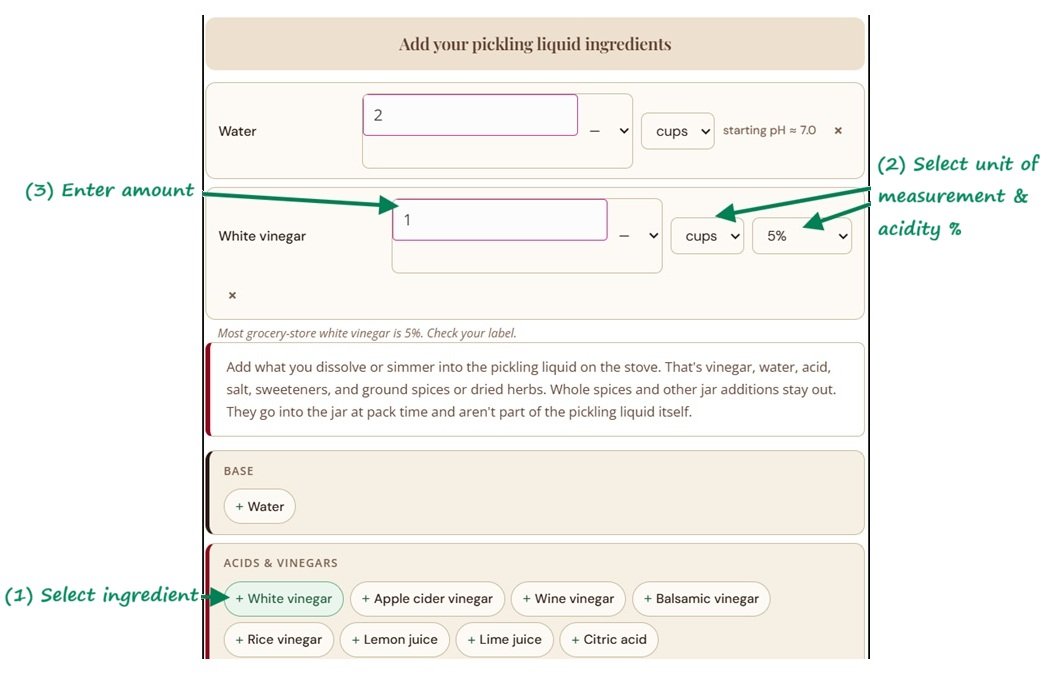
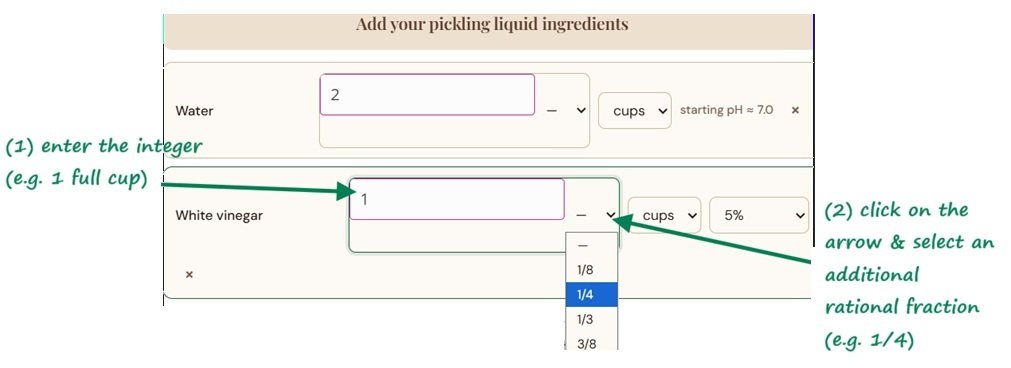
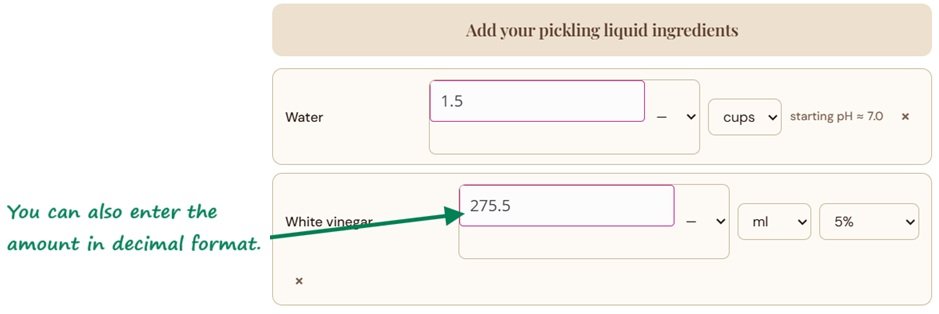
Click the buttons to add each ingredient that goes into your brine. Each ingredient appears as a row where you set:
- The amount. Cups, tablespoons, teaspoons, millilitres. Whatever unit your recipe uses.
- The acidity percentage, for vinegars. Read the label. Most say “5% acidity” or “diluted with water to 5% acidity”. If your bottle is 4%, pick 4%. If it’s 6%, pick 6%.
- The vinegar type. Pick one or more vinegars you plan to use in your brine
Add as many ingredients as your recipe calls for.
Step 2. Estimate the pH
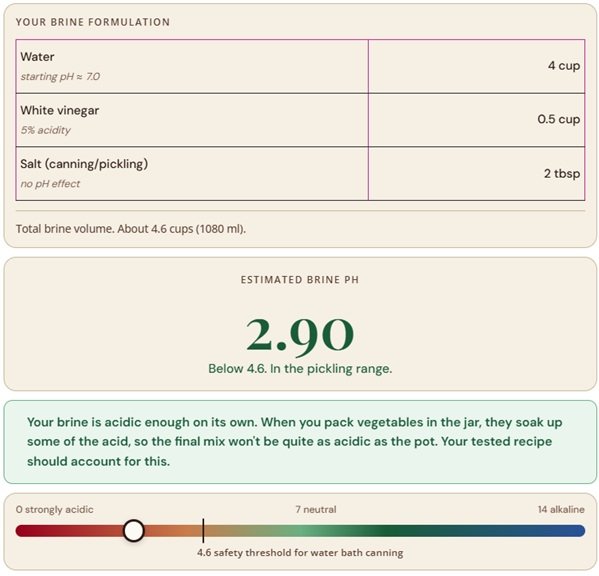
Click Estimate brine pH. The tool runs through your ingredients and displays:
- An estimated pH value, the predicted pH of the brine before processing
- A visual placement on the pH scale, showing where your brine sits relative to the 4.6 safety threshold for water bath canning
- A plain-language summary telling you whether you’re in the safe zone, borderline, or above the threshold
- Next-step guidance: what to verify and what to consider if your result isn’t where you want it.
What if you change your mind?
You can adjust amounts and ingredients freely. Any change after a calculation flags the result as out of date. The button itself turns red, and its label switches from “Estimate brine pH” to “Recalculate brine pH“. Click it to refresh.
What the tool will tell you when something is off
The calculator handles a few edge cases so you don’t get misleading numbers. Such as unrealistic quantities of ingredients added to your brine formulation.
When the calculator is most useful
- Designing a new pickle recipe. Try different vinegar-to-water ratios, different acids, different blends before you commit.
- Adapting a recipe. See what happens when you swap apple cider vinegar for white, or add lemon juice for tang.
- Sanity-checking a recipe from somewhere else. Type in the brine ingredients before you decide whether the recipe is starting in the right pH range.
- Comparing 4% and 5% vinegars. The difference between them shows up the moment you switch the drop-down.
What pH does pickling brine need to be?
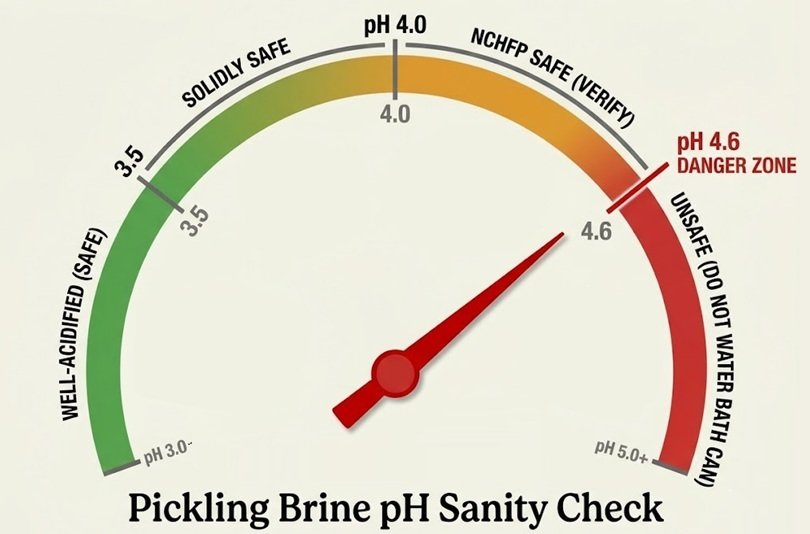
The number that matters in home canning is pH 4.6.
- Anything at pH 4.6 or below is classified as high-acid and can be safely processed in a boiling water bath.
- Anything at pH 4.7 or above is low-acid and must be pressure canned.
This threshold comes from the National Center for Home Food Preservation (NCHFP), and it’s the line every tested recipe in the USDA Complete Guide to Home Canning, the Ball Blue Book, and Bernardin Guide to Home Preserving is built around.
But there’s a more conservative number worth knowing about. Commercial canners, and a lot of tested home canning recipes, actually target pH 4.3 or lower, not 4.6. That margin gives a buffer for measurement error, vegetable variation, and what happens to acid once it’s in the jar with the produce.
That’s why our pickling brine pH calculator on this page uses conservative pH values for every ingredient. It estimates toward the higher end of each ingredient’s natural range, so if it tells you your brine is at pH 3.6, it’s likely a bit lower in reality. If it tells you your brine is above 4.6, you have a problem regardless of measurement slop.
A few rough targets to keep in mind:
- pH above 4.6: Outside the safe zone for water bath canning, period.
- pH 3.0 to 3.5: Typical for a 1:1 vinegar-to-water brine using 5% acidity vinegar -a well-acidified pickling brine.
- pH 3.5 to 4.0: Still solidly safe; many tested recipes land here.
- pH 4.0 to 4.6: Above the commercial target but still within NCHFP’s safe zone -verify with a meter before processing.
Why this tool estimates pH before vegetables go into the jar
For starters, this tool does not measure pH. It estimates from your ingredients. For an actual measurement, use a calibrated pH meter or test strips.
Secondly, it estimates the brine before processing, not the contents of the jar afterwards. Two things happen between the brine you mix and the jar you eventually open, and the calculator can’t model either one:
- Vegetables dilute the acid. Cucumbers are about 95% water and have a natural pH around 5.1 to 5.7. When cucumbers sit in your brine, they release water (lowering the brine’s acid concentration) and absorb acid (carrying some of it into the vegetable). The final equilibrium pH inside a sealed jar of pickles is somewhere between the brine’s starting pH and the vegetable’s natural pH. The same applies to peppers, onions, carrots, beans, and every other vegetable you might pickle.
- Some acetic acid is lost during processing. If you simmer the brine too long, you lose total acid volume to steam and evaporation. Our own brine recipes specify to add the acid after the brine has come off the boil. This approach helps to minimize loss and preserve the brightness of acids. The calculator estimates the pH of the brine as you mix it, not the pH after it’s been cooked down.
Both of these effects push the finished jar’s pH higher than the brine’s starting pH, which is why you want headroom. A brine that estimates at pH 3.4 has plenty of margin. A brine that estimates at pH 4.4 is borderline before either effect has happened. Meaning, the jar may end up above 4.6 even though the brine looked fine.
- It does not replace a tested canning recipe.
- It is not a safety determination. It’s a sanity check on the brine before processing. Verify with a pH meter or test strips for any recipe you haven’t canned before.
Which vinegars are safe for canning, which aren’t?
Not all vinegar is canning vinegar. The rule for water bath canning: at least 5% acidity, labelled on the bottle. Anything below that is not strong enough to deliver the acid your recipe was tested with.
Safe for canning (5% acidity or higher):
- White distilled vinegar (5%). The workhorse. Most widely tested. Neutral flavour, doesn’t tint the brine, cheapest.
- Apple cider vinegar (5%). Safe, but adds golden colour and mild fruity flavour. Good for bread-and-butter style pickles. Confirm 5% on the label, since some specialty ciders are lower.
- Wine vinegars (typically 6 to 7%). Higher acidity than table vinegar, but the percentage varies by brand. Always read the label.
- Cane and coconut vinegars. Safe if 5% or higher and labelled as such. Less commonly used in tested recipes.
Use with caution:
- Rice vinegar. Most brands ship at 4 to 4.3% acidity. Not safe for canning on its own. A few brands are 5% or higher: read the label every single time. If yours is below 5%, don’t substitute it directly into a tested recipe.
- Balsamic vinegar. Acidity varies wildly. Traditional balsamic is around 6%, but commercial balsamic glazes and reductions can be much lower. Use only if labelled 5% or higher.
- Homemade vinegar. Acidity is unknown unless tested in a lab. Not recommended for canning.
The brine pH calculator on this page handles all of these: white, cider, rice, balsamic, wine vinegars, and malt, at whatever acidity percentage is on your bottle. Pick the type, set the percentage, and the tool does the rest.
Lemon juice, lime juice, and citric acid
When a recipe needs more acid than vinegar alone can provide, or when vinegar’s flavour is wrong for the application, three other acidifiers come in:
- Bottled lemon juice (pH around 2.3). Stronger than vinegar, less flavour impact. The reason recipes call specifically for bottled is that fresh lemon juice has variable acidity depending on the fruit. Bottled is standardised by the manufacturer and predictable.
- Bottled lime juice (pH around 2.4). Same logic as lemon juice. Used interchangeably in tested recipes. Don’t substitute fresh.
- Powdered citric acid. Very strong, very flavour-neutral. A quarter teaspoon per pint is the standard substitute for one tablespoon of bottled lemon juice. Useful when you want the safety of added acid without changing the taste.
The brine pH calculator on this page lets you mix any of these acids in any combination. Vinegar plus citric acid. Lemon juice plus citric acid. Three vinegars at once. Whatever your recipe actually calls for. It also lets you add the non-acid ingredients that show up in real brines: salt, sugar, honey and maple syrup, soy sauce and mirin, and the ground spices and dried herbs (dry mustard, turmeric, ginger, cinnamon, thyme, oregano, marjoram, dill weed) that get cooked into the liquid. They don’t dominate the pH the way vinegar does, but they’re part of your actual brine, and the tool tracks them so you can model your real recipe instead of a simplified version of it.
Frequently Asked Questions
There are two ways to look at your brine’s acidity:
–The Calculator (Before you brew): Type your ingredients into the tool on this page, including vinegars (with acidity %), citrus juices, or citric acid, and water. In about ten seconds, it estimates the pH using conservative, published values for each ingredient.
–The pH Meter (After you brew): For any recipe you plan to shelf-store, you should always verify the finished liquid with a calibrated pH meter or test strips.
💡 Remember: The calculator provides a safe estimate before it’s made. The meter gives you the absolute reality after.
Yes, in two ways: by acidity percentage and by acid type.
-The biggest variable is the acidity percentage on the label. A brine made with 5% white vinegar and one made with 4% rice vinegar will land at very different pH values. This is why tested canning recipes specify “5% acidity”, anything below that alters the chemistry, meaning the recipe is no longer verified as safe.
–Acid type matters less, but it isn’t zero. While white distilled, apple cider, and wine vinegars at 5% strength sit in a similar pH range (around 2.4 to 2.6), cider vinegar is typically slightly less acidic than distilled. The calculator below lets you plug in your exact vinegar type and percentage to see the difference instantly.
Negligibly little. Sugar and salt aren’t acids or bases, so they won’t move the pH dial. They change the brine’s flavour, texture, and (for salt) its osmotic effect on vegetables, but they don’t change its chemical acidity.
What sugar and salt do affect is the brine’s behaviour inside the jar over time: high-sugar brines preserve differently from low-sugar brines, and salt is essential to fermentation pickles for keeping pathogenic bacteria suppressed while lactic acid bacteria do their work. But for the question of “is this brine acidic enough to water bath can?” – sugar and salt are not the levers. The vinegar, acid, and water ratios are. Use the brine pH calculator on this page to focus on those.
No, you shouldn’t. The NCHFP, the USDA, and all major canning authorities specify a minimum of 5% acidity vinegar for safe shelf storage. Because a 4% vinegar delivers 20% less acid for the same volume, it can quickly push a borderline recipe into unsafe territory. Most rice vinegars sit around 4% to 4.3%-which is why you have to read the label carefully every time.
If the only vinegar you have on hand is below 5%, you have three safe choices. You can switch to a standard 5% vinegar, pivot to a refrigerator pickle recipe (no canning required), or use the brine pH calculator below to see how boosting it with bottled lemon juice or citric acid impacts the math.
If you choose to modify the recipe using the calculator, always verify the finished liquid with a calibrated pH meter before processing your jars.
Join the pantry
Fresh recipes when the season calls for them. Preservation guides you can trust – every method, traditional to modern. Ideas for turning your pantry into weeknight dinners. Seasonal alerts that help you preserve more for less. Honest reviews of the tools that matter.
Related Tools:
Canning Altitude Lookup
Find your altitude band so you can use the correct row in your recipe’s processing-time or pressure table.